
 Lincoln, IL-(Effingham Radio)- This week is Severe Weather Preparedness Week.
The National Weather Service in Lincoln has released the following facts and safety tips:
Tornadoes
Fast Facts
- Illinois ranks 4th in the United States for the most tornadoes per square mile
- Half of all Illinois tornadoes occur in central & eastern IL, but this region (our CWA) only accounts for 35% of the state’s area.
- The six months with the most tornadoes the past ten years include: June, May, August, July, December and November. For the second year in a row, two winter months remain in the top 6 tornado months in the last 10 years. Fifty percent (50%) of Illinois tornadoes occur between the hours of 3 p.m. and 7 p.m. However, tornadoes have occurred every month of the year at all hours of the day.
- Nearly 20 percent of all tornadoes in Illinois occur after dark, which included most of the tornadoes on our Dec 10, 2021 tornado outbreak.
- On average, 54 tornadoes occur each year in Illinois, based on 1991 to 2020 data.
- The year with the most tornadoes in Illinois was 2006, when 124 tornadoes occurred. Two years had no tornadoes, 1919 and 1933.
- There were 35 tornadoes reported in Illinois during 2022, which was a relatively low year compared to the 75 tornadoes in 2021, which was #5 overall since 1950. The 2022 tornadoes resulted in no fatalities and no injuries which was good to see. The strongest tornado, and only EF2 tornado, occurred in Wabash County in far southeast Illinois on May 19. A total of 24 tornadoes were rated EF0 or EF1 (weak). The remaining 10 tornadoes were given an EF Unknown rating because they were either very brief tornadoes OR they traveled across open areas where there were no crops, trees or buildings in their path.
- The day with the most tornadoes in the state of Illinois in 2022 was May 19th. A total of 5 tornadoes were reported across central and southern Illinois. April 30th, 2022 was second, with 4 tornadoes in central and northern Illinois.
- In Illinois since 1950: 76 percent of tornadoes have been weak with wind estimated less than 110 mph, o 23 percent of tornadoes have been strong with wind estimated between 110-167 mph, 1 percent of tornadoes have been violent with wind estimated greater than 167 mph.
- The last violent tornado in Illinois occurred on April 9, 2015, from just north of Rochelle to the village of Fairdale.
SAFETY During a Tornado
Watch vs. Warning:
- A WATCH means that conditions are favorable for severe weather to occur, usually in a 6-10 hour period. “WATCH” for more information.
- A WARNING means that severe weather is occurring or about to occur soon for your area (next 30-60 minutes). We are “WARNING” you to stop what you are doing and seek safe shelter.
Take the following actions when a Tornado Warning has been issued by the National Weather Service, when sirens have been activated or when a tornado has been sighted near your area:
- Monitor a weather radio, radio, TV, weather app, or social media for the latest information.
- Go immediately to your predetermined shelter, such as a storm cellar, basement or the lowest level of the building. In a basement, go under the stairs, under a heavy piece of furniture or a work bench. Stay there until the danger has passed.
- If in a mobile home, get out and seek shelter elsewhere, well before the storm arrives. A mobile home can overturn very easily even if precautions have been taken to tie down the unit. If there is not a substantial shelter nearby, go to a low-lying area and shield your head with your hands.
- If there is no basement, go to an interior hallway or a small interior room without windows, such as a bathroom or closet. Stay away from outside windows and walls as they may be penetrated by high speed, wind-borne debris.
- Get under a piece of sturdy furniture, such as a workbench or heavy table, and hold onto it. If sturdy furniture is not available, make yourself the smallest target possible. Squat low to the ground. Put your head down and cover your head and neck with your hands.
- Use pillows, mattresses or cushions to protect your head and neck.
Outdoors:
- If possible, get inside a substantial building on the lowest floor, away from windows and doors.
- If an indoor shelter is not available or there is no time to get indoors, then, as a last resort, lie in a ditch or culvert. Use your arms to protect your head and neck. Beware of the potential for flash flooding.
In a Vehicle:
- Do NOT park under a bridge or overpass! The embankment under an overpass is higher than the surrounding terrain, and the wind speed increases with height. Additionally, the overpass design may create a wind-tunnel effect under the span, further increasing the wind speed. Many overpasses are completely exposed underneath, and most lack hanging girders or a crawlspace-like area to provide sufficient protection from debris, which can travel at high speeds even in weak tornadoes. People stopping underneath overpasses block the flow of traffic, putting others in danger.
- Immediately exit the vehicle in a safe manner and take shelter in a nearby building.
- Never try to outrun a tornado in a vehicle. Heavy rain, hail and traffic may impede your movement. Tornadoes can change directions quickly and can easily lift up a vehicle and toss it through the air.
- As a last resort, if there isn’t time to get indoors or if there is no secure shelter nearby, lie flat in a ditch, culvert or low-lying area away from vehicles.
Severe Thunderstorms & Lightning
Fast Facts
- Illinois averages 860 reports of wind damage and large hail annually. Too often, people ignore severe thunderstorms because they believe only a tornado will cause damage or threaten their lives. The fact is, a majority of the property damage and injuries each year is from high winds and large hail.
- Severe thunderstorms produce tornadoes, damaging winds, lightning, hail or heavy rain
- High wind from straight-line winds and downbursts can cause more damage than nearly 75 percent of the tornadoes that occur in Illinois
- A devastating, long lived line of severe thunderstorms called a derecho, tracked from Iowa into Illinois on August 10, 2020. Wind gusts of 70 to 100 mph were reported in 31 counties in northern Illinois. Ten people were injured and damages were hundreds of millions of dollars.
- One of the largest hailstones ever reported in Illinois fell near Minooka (Kendall County) on June 10, 2015. The hailstone was 4.75 inches in diameter, which is bigger than a grapefruit! Damages in excess of $100,000 were reported with this hailstorm.
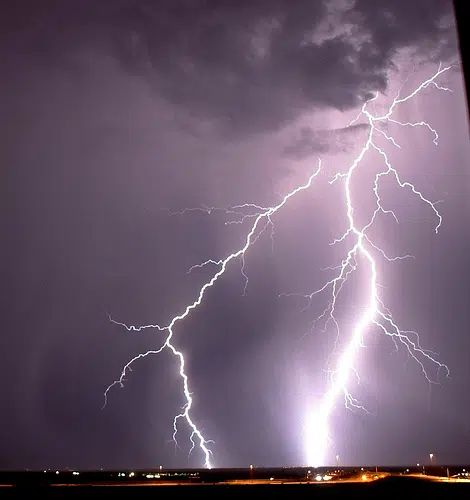
- Most lightning deaths occur while people are fishing OR under/near trees. • Illinois ranks 8th in the U.S. for the most lightning strikes per square mile each year
- Lightning is to blame for 107 deaths in Illinois since 1960
SAFETY During A Severe Thunderstorm and/or lightning
- It is critical that someone at home, work or wherever people gather monitors weather conditions, regardless of the time of day. Monitor watches and warnings in your areas using a weather alert radio, cell phone app, local TV, local radio or the Internet. If it is safe to do so, contact family members and friends when you become aware of a severe thunderstorm and/or lightning that may threaten them.
- Check the weather forecast before leaving for extended outdoor periods and postpone plans if severe weather is imminent.
At Home and Work:
- Monitor the radio, television or Internet for the latest weather information
- Stay away from all windows and exterior doors during the storm. If you can do it safely, draw the window shades or blinds to reduce the risk from flying glass shattered by high winds.
- Turn off air conditioners. In the event of a lightning strike, a power surge could damage the compressor
- Delay taking baths or showers until after the storm passes due to the lightning threat Outdoors:
- If outdoors, seek shelter immediately. If you can hear thunder, you are close enough to the storm to be struck by lightning.
- If you find yourself in a position where there is no immediate shelter available, find a low spot away from trees and power poles
- If you are in a boat when a thunderstorm threatens, you should attempt to reach shore as quickly as possible
- If you are driving, pull safely to the shoulder away from trees and power lines. Lightning can flash from trees or power poles and strike a vehicle. Rubber tires do NOT keep lightning from striking a vehicle. In the open, a hard-topped vehicle is normally a safe shelter from lightning. Avoid touching metal parts of the vehicle when lightning is nearby.
Flooding
Fast Facts
- Fourteen people died as a result of driving across flooded roads in 2015, 11 of whom perished during the major flood in late December 2015. This was the highest annual number of flood fatalities since records have been kept.
- Prolonged flooding from creeks and rivers and flash flooding from rain swollen roads and waterways are dangers that too many people ignore, sometimes with fatal consequences.
Many flood-related rescues, injuries and fatalities have been the result of people in vehicles attempting to drive across flooded roads.
- The most dangerous type of flooding is a flash flood. Flash floods can sweep away everything in their path. Urban flash flooding is becoming more common due to ageing sewer systems and improper drainage.
- Most flash floods are caused by slow-moving thunderstorms and occur most frequently at night.
- Flooding has been a factor in 53 deaths across Illinois since 1995. This is more than the number of people killed by tornadoes during the same period. Many of these flood fatalities (77%) involved people in vehicles trying to cross flooded roads.
During a Flood
- Monitor a weather radio, radio, TV or Internet for the latest weather information and evacuation instructions
- If advised to evacuate, do so quickly.
- Evacuation is much simpler and safer before flood waters become too deep for vehicles. • Follow recommended evacuation routes. Short cuts may be blocked.
- Move valuable household possessions to an upper floor or another location if flooding is imminent and time permits.
- If instructed to do so by local authorities, turn off utilities at their source.
- Many people have lost their lives by attempting to drive over flooded roadways. The speed and depth of the water is not always obvious. There may be a hidden portion of the roadway washed out under the water. Two feet of water will carry away most automobiles.







Comments